Showing posts with label religion. Show all posts

29 December 2010

La Virgen de la Almudena

Almudena Cathedral is the cathedral of Madrid, Spain. Dating from the late 19th and 20th centuries, It's very new by European standards, and its traditional-meets-modern design reflects its youth.

History of the Cathedral

The site on which Almudena Cathedral now stands was originally occupied by Madrid's first mosque, then by a church dedicated to one of Madrid's patron saints, Santa María de la Almudena.

Plans for a grand new church began in the 16th century after King Philip II made Madrid the capital of Spain. But construction was constantly postponed due to various political issues and opposition from the powerful archdiocese of Toledo.

Finally, in 1868, Madrid received permission from Toledo to construct a new church dedicated to the Virgin of Almudena. Construction began in 1883 based on a Neo-Gothic design. The first part to be completed was the crypt, which contains a 16th-century image of Madrid's patroness the Virgen de la Almudena.

A year later, in 1884, Pope Leo XIII created the Diocese of Madrid, giving Madrid a bishop and raising the status of the new Almudena church to a cathedral. The building plans were updated to reflect the elevated status of the building.

Construction on the cathedral progressed slowly and came to a complete halt during the civil war of the 1930s. The process began again in 1944, when the new architect introduced a Neoclassical style that would match the Royal Palace next door.

Almudena Cathedral was completed in 1993 and consecrated in person by Pope John Paul II that same year. A statue of the pope in front of the cathedral commemorates the momentous occasion. The cathedral was given another publicity boost with the sumptuous wedding of Prince Felipe and Doña Letizia in May 2004, the first such royal event in nearly a century.

http://www.sacred-destinations.com/spain/madrid-almudena-cathedral

History of the Virgin-
I read about the history of the Virgin in Spanish so I'll give you a small run-down of how it came to be.

Basically in 712 Spain's capital was in Toledo (Madrid didn't become the capital until the 13th century). That year, the king was overthrown by the Muslim army and they established their strongholds in Toledo.  However, Madrid was still a strategic place for any army.  Fearing the coming invasion, the cristians of madrid decided to hide their images of the Virgen Mary and protect her from the infieles "non-believers"

Sermon given by priests to the Madrilenos after the fall of Toledo:

"Hijos míos: Los enemigos de nuestra fe han invadido todas las ciudades, villas y aldeas de España. ¡Es inútil la resistencia! ¡Dios así lo quiere! Es preciso que acatemos su santa voluntad, pidiendo de rodillas perdón por nuestras culpas. El que se encuentre con fuerzas para pelear, que pelee hasta morir en defensa de nuestra sacrosanta religión. Y aquel que sobreviva al duro combate, en el que sin duda seremos vencidos, que corra hacia las montañas donde se reúnen las huestes de los soldados de la Cruz, al mando de don Pelayo, para hostigar cuanto puedan a los invasores y trabajar por la libertad de la Patria. (Ver: Virgen de Covadonga)
Muza está en Toledo; conquistada esta ciudad, pronto el infiel caudillo se hallará delante de nuestros muros; antes de que esto suceda, antes de que Madrid caiga en sus manos, es preciso que pensemos en salvar los objetos que nos son más queridos. La Virgen Santísima, a quien tanto veneramos, que siempre ha sido nuestra abogada y protectora, que siempre ha oído clemente nuestras preces, no ha de caer en manos de nuestros enemigos, no hemos de permitir que su preciosa imagen sea profanada por los infieles.
Ocultémosla, mientras peleamos contra ellos, en el cubo de esta muralla contigua a este santo templo. Si vencemos, todos sabemos dónde la hallaremos para darle gracias por la victoria, y si, por desgracia, somos vencidos, líbrese, oculta en la muralla, del furor de los mahometanos".

So the Madrileno christians built a hub in order to hid the Virgen and there she stayed for three centuries.  Her whereabouts were lost through the generations but carefully hidden away from the non-believers that occupied Madrid soon after the Virgen was hidden away. 

In 1085, Don Alfonso VI "The Brave" reconquered Toledo and then returned to Madrid to restore the power to the Christians.  He knew of the legend that the Virgen was hidden hundreds of years ago so he set out to find the secret hub.  The original church had been converted into a Mosque so Don Alfonso searched and searched until it is said that the Virgen herself appeared surrounded by light and led the way to her hiding place somewhere in the original site of the church turned mosque on the 9th of November 1085. 

The following day, the Christians of Madrid held a procession to the remains of the original church looking for her exact location.  Soon they encountered an ancient wall below the sub-level of the mosque.  And what would they find behind this wall, but the Virgen that was hidden centuries before.  She was placed back to her original status as the Christians regained power in Spain.  Over the next few centuries, the Virgen was moved from church to church throughout different cities but after the construction of the Almudena Cathedral where she resides today.

My Experience

The Virgen of the Almudena is a holiday only in Madrid.  Therefore, I never learned anything about this holiday nor its legend in my studies or really throughout my time here in Madrid.  As a matter of fact, most people I asked (even the Spaniards) didn't really know the exact history of the holiday.  All they knew was that it was a day off in order to praise the Patron Saint of Madrid. This particular holiday fell in line with Spain's Constitution Day so it made for a very short work week. 

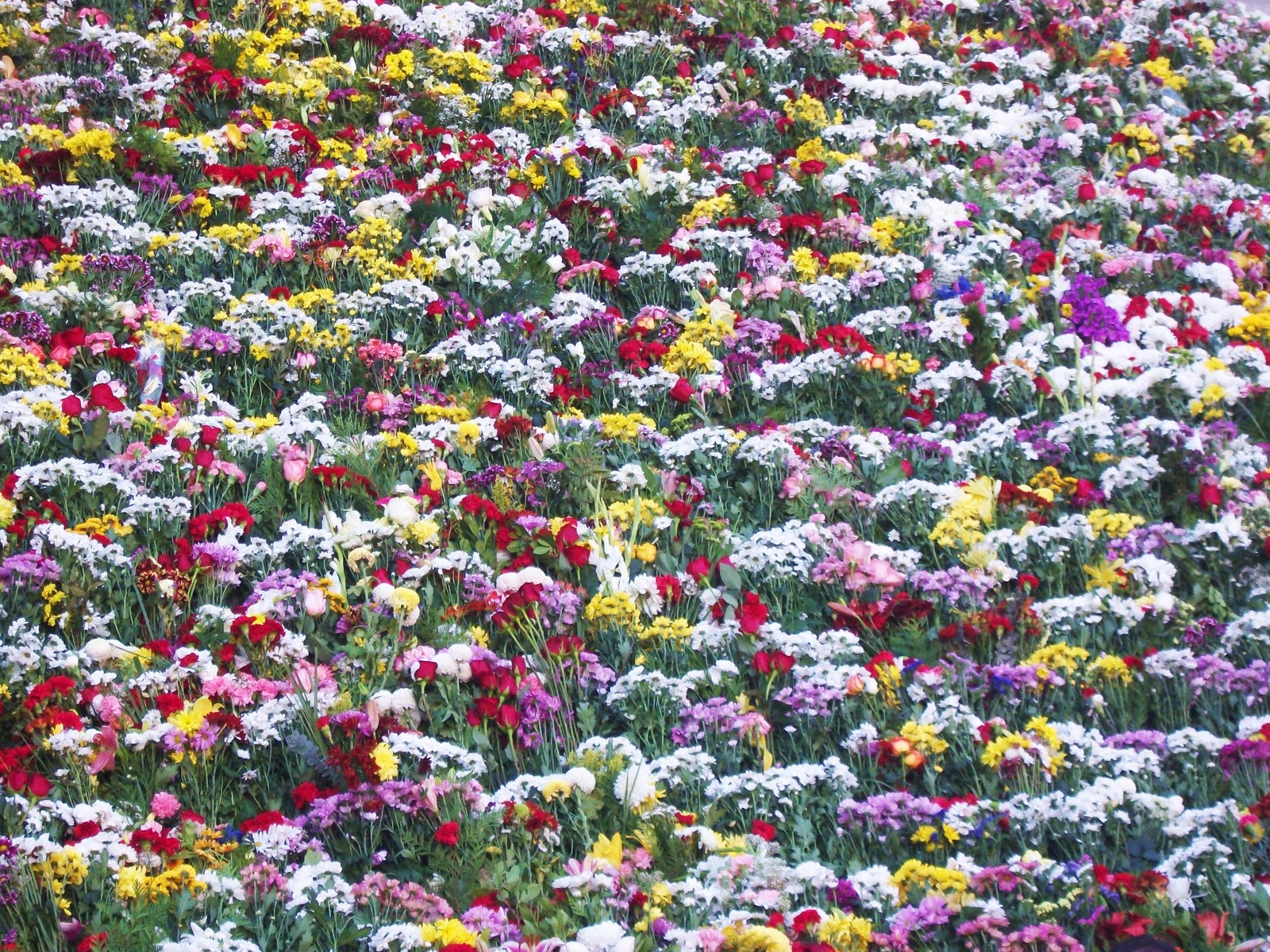
Most of this windy, chilly day I stayed around the house cleaning.  But in the early afternoon I decided to hit up some shops up near Opera/ Sol and then stroll through the Palace gardens and towards the Almudena Cathedral to see what all the fuss was about.  Once I entered the gardens, there were buckets and buckets lining the street with vendors chanting at everyone to buy small bundles of flowers.  "Flowers for the Virgen! Get your flowers for the Virgen!" 

As I got closer to the Cathedral, I noticed that every other person had an offering of flowers.  Some were the small bundles from the street vendors while other had enormous, beautiful bouquets.  When I reached the corner I realized just how important La Virgen de Almudena was in Madrid. 


It was quite the spectacular sight to see.  I clicked some photos and walked around the Cathedral watching all the people give their offerings and say a little prayer at the base of the statue of the Virgen.  I wanted to step inside the Cathedral to see if there were anymore decorations but a service had just gotten out and no one was allowed to enter at that time.  So I made my way back around the side streets passing more and more people with their flowers.  Yet another great example of how much importantance Spain puts on the Christian religion. 

Websites:
http://www.corazones.org/maria/almudena.htm
http://www.madridpedia.com/node/1325/

15 June 2010

Semana Santa 2010


Semana Santa or 'Holy Week' starts Spain's Spring Break around the time of Pascual or 'Easter'.  Obviously being in 'Catholic Spain', I had some very high expectations.  All week long from the end of March to the beginning of April.  I got a full week off of work which was nice as I was in need a descanso.  I had just come back from Vigo the weekend prior and was planning another trip to Salamanca in the week that followed, so I had a completely empty agenda for this week which was just what the doctor ordered.
I borrowed one of my colleague's Madrid tour books and started to scan through it one day.  I was amazed about how many things in Madrid I had never been to or even knew existed.  So I decided to utilize this time to check out what secrets were hiding in this massive city. 

I must admit that I slept in almost every day and put no urgency to accomplish much of anything.  I enduldged myself with long dinners and copias amounts of drink during this week with some of my friends.  However, I did get around to seeing some pretty awesome things.

One day, Craig, Irene, my amazing Italian roommate and I went for a long stroll around Parque Oeste and the Royal Palace.
Another day was spent at the Soralla Museum only minutes from where I live.
Yet another day was spent in the city that will forever have my heart... TOLEDO!
And the rest were spent cleaning, shopping and general walk-abouts in the centro.

  Me (left) and My Roommate Irene (right)

What I want this blog to be mostly about it the festivities revolving around Semana Santa in Madrid.

I really like this BLOG's review of Semana Santa in Spain... so check it out if you want more info!

One of my goals was to sit in on a Catholic mass in one of Madrid's hundreds of iglesias.  I got that opportunity during my stroll with Craig and Irene.  I intended on going to a small church near my apartment but when we were passing the Cathedral near the Royal Palace and I saw that there was a service going on at that moment, I thought... what the hell! (Sorry for the blasphemy!)

It was also my first time inside the Cathedral here in Madrid so it was quite the experience for me.  We stayed about 20 minutes as the crowds of people left no where to sit.  But I was really moved by the Latin service and choir.  I'm not a religious person by any means but it's still one of those cultural experiences that really have an impact on a person. 

The one event during Semana Santa I knew I couldn't miss was
'La Procession de Silencio'
view from inside the parade heading towards PUERTA DE SOL

It starts near Atocha and continues down towards Sol wraps around and continues back.  It would seem like any normal religion based- Easter parade with exception to some crazy outfits and suprising offerings of penance. Well, I'll let you see for yourself...
Hopefully, I don't have to explain that the outfits have absolutely NOTHING to do with the KKK!
The people are called Nazarenos; they wear these costumes as a way to demonstrate their penatence to heaven.  Every major city in Spain has a different group of Nazarenos that each have their own colored costumes and different ways to distinguish themselves from one another.  It is considered a great honor throughout Spain to become a Nazareno.


The second picture demonstates common people usually members of that group's particular church who want to ask for foregiveness for their sins through this walk of 'disgrace'.  They walk barefoot shackled with chains; the more chains, the more forgiveness you're asking for.  Nowadays, it is a more symbolic tradition. 


Well here are some more photos of the parade to help you get an idea of what a spectacle it was! Enjoy :)


16 February 2010

More Christmas Festivals in Spain

Historical Background:

December 28th is 'Día de los santos inocentes' or 'Day of the Innocent Saints' and is very like Aprils Fools Day in the UK and USA. People try to trick each other into believing silly stories and jokes. Newspapers and TV stations also run silly stories. If you trick someone, you can call them 'Inocente, inocente' which means 'innocent, innocent'. 28th December is when people all over the world remember the babies that were killed on the orders of King Herod when he was trying to kill the baby Jesus.

Apart from Christmas, there is another festival that is celebrated in Spain that is about the Christmas Story. It is called Epiphany or Kings' Day and is celebrated on 6th January. This is the twelfth night after Christmas. In Spanish, Epiphany is called 'Fiesta de Los tres Reyes Magos': in English this means 'The festival of the three Magic Kings'. Epiphany celebrates when the Kings or Wise men brought gifts to the baby Jesus.

Children have some presents on Christmas Day, but most are opened at Epiphany. Some children believe that the Kings bring presents to them at Epiphany. They write letters to the Kings on Boxing Day, December 26th, asking for toys and presents. And on Epiphany Eve (January 5th) they leave shoes on windowsills or balconies or under the Christmas Tree to be filled with presents. Gifts are often left by children for the Kings, a class of Cognac for each King, a satsuma and some walnuts. Sometimes a bucket of water is left for the camels that bring the Kings! If the children have been bad, the Kings might leave pieces of coal made out of sugar in the presents!

Some big towns and cities have Epiphany Parades with each King having a big float that is shaped like a camel. Sometimes there are also real camels in the parade. The Three Kings in the the Spanish Epiphany are:


• Gaspar, who has brown hair and a brown beard (or no beard!) and wears a green cloak and a gold crown with green jewels on it. He is the King of Sheba. Gaspar represents the Frankincense brought to Jesus. Frankincense is sometimes used in worship in Churches and showed that people worship Jesus.

• Melchior, who has long white hair and a white beard and wears a gold cloak. He is the King of Arabia. Melchior represents the Gold brought to Jesus. Gold is associated with Kings and Christians believe that Jesus is the King of Kings.

• Balthazar, who has black skin and a black beard (or no beard!) and wears a purple cloak. He is the King of Tarse and Egypt. Balthazar represents the gift of Myrrh that was brought to Jesus. Myrrh is a perfume that is put on dead bodies to make them smell nice and showed that Jesus would suffer and die.

A special cake called 'Roscón' is eaten at Epiphany. Roscón means 'ring shape roll'. It is very doughy and is bought from a bakery on Epiphany morning. Roscón can be filled with cream or chocolate and contain a little gift.


Personal Experience:

After Christmas and New Years my holiday was abruptly coming to an end. I was preparing for the start of a new semester at work as well as spending as much time enjoying what was left of my vacation. 'Día de los Santos Inocentes' passed without my knowledge. I watched the news the next day as they reviewed some of the celebrity pranks that had occurred. Then I remembered but wasn’t bothered either way.

Los Reyes Magos is a very important holiday here so I anticipated celebrating it in some way. The night before was a huge parade covering half the city; so, a few of teacher’s and I went to watch it then out for a few drinks later that night to watch an important ‘futbol’ match. The days surrounding, I walked around the main center of Madrid and looked at all the decorations and street performers that had all the children eagerly anticipating the 3 King’s arrival. However, my first work meeting of the year was the actual night of the holiday. So I missed most of my roommates’ celebration with the 'Roscón'.
I got a piece of it later that night but didn’t get to experience it in the real Spanish manner. The following day classes began so it was a quick holiday for me. Overall, I feel it is really difficult for a foreigner to truly appreciate this holiday in the true Spanish way. It was fun to see all the families, especially the children, so happy for something other than Santa Claus. It was a nice culture difference but not one that I can really explain to its full importance.

25 November 2009

La Virgen de la Paloma

One of Madrid's oldest and most celebrated fiestas, the Virgen de la Paloma, begins on August 11th and culminates on the 15th.

The fiesta has taken place since the 18th century in the Plaza de las Vistillas, which itself is an excellent example of old Madrid.Behind the celebration of the Virgen de la Paloma - which translates as the Virgin of the Doves - is the story of Maria Isabel Andrea Tintero, who healed one of the children of Queen Maria Luisa.

To this day, the climax of the fiesta remains the procession of a statue of the Virgin of the Doves, carried by the city council firemen from the Plaza de las Vistillas and through the streets and squares of the surrounding area.

However, the celebrations start much earlier than that, with events beginning four days before. Concerts, dancing and street performances can be found on every corner. The event remains a traditionally Spanish feel, with many of the locals dressing in Madrileño costume. Visitors can observe the men and women of the region dancing the chotis as they wear Chulapo outfits and shawls respectively.

http://www.fiestas-de-madrid.com/

Personal Experience:


Well as usual, I didn’t know any of the background of this holiday before I wrote this blog. I just knew that it was another excuse for dressing up, heavy drinking and dancing in the streets of Spain. This particular fiesta is special to Madrid. At the time, I was still living in Toledo but I knew from the stories I was hearing that I had to take part in at least one night of La Paloma. I finished out my work week and returned to Toledo. The next day I made plans to meet up with one of my colleagues, Luke, that I was quickly becoming friends with. I hopped the late morning bus back to Madrid and took the metro to Luke’s barrio. I met up with a bunch of his friends that I had met some weeks earlier when they came to visit me in Toledo. We went back to Will’s place and relaxed because they were still recovering from the previous night’s festivities.
When night fell, we hit up a small bar for some tapas and drinks then met up with some more of his friends. The streets were already becoming more and more crowded by the minute.

The small group of us went to a nearby ‘chino’ to get our take in beverages for the night as this is one of the few occasions where excessive alcohol consumption is completely ignored by authorities. We roamed the streets of La Latina with our full cups of calimocho as I took in every second of the insanity. We did the cultural part and stopped by one of the churches that held a procession for the religious ceremonies. I love Spain’s deeply rooted religious undertones to all their holidays; they definitely haven’t been overtaken by the novelty business as the US has been.


After I took my fill of touristy pictures, we found a corner to rest on while we drank and socialized. There were people in traditional dress, actors in full-costume, drunken tourists running around and wide-eyed children taking in the spectacle. Around midnight there was an amazing firework display. After our bag of drinkable goodies was gone, the group and I walked back to the main plaza where we hunted down some more beer. We sat in the plaza until early morning with groups on Spaniards drinking, dancing and signing along with hardcore “American pop.” Haha

A few of us staggered our way back to Will’s where we crashed around 6 am. Luke and I went out to this pretty tasty Indian place the next morning and by mid afternoon I was back in Toledo trying to recall the madness that happened in the last 24 hours. Definitely 2 thumbs up for La Virgen de la Paloma.