Shortly after moving to Madrid in September of 2009, I found an apartment just 5 minutes from my previous academy. I wanted to live with a few Spaniards in order to practice Spanish more. Being in a rush to move our of the previous place I was living, I took a room with 2 Spanish guys and a Swiss girl. The roommates changed every few months as the Swiss girl returned home and other people moved in and out. That is for the exception of one guy who we´ll refer to as El Diablo (aka ED).
Well, we had our normal roommate drama within the house. You know things like someone didn´t wash their dishes and who was the last person to buy papel higenico (toilet paper)... things like this.
I lived there until the end of June 2010 when I finally decided I wanted a change in scenery. Plus, I went home to the US for all of July and didn´t really want to pay rent for a room I wasn´t going to be living in.
I told my roommates at that time of my plans, including El Diablo and everything was fine. I started packing up little things as I looked for a new apartment to move into that next August. As May was coming to an end, I asked ED if he wanted to use my fianza (security deposit) to cover my last month of rent. He said he´d prefer if I paid so he could collect my deposit by the end of the month. I STUPIDLY agreed not thinking it was abnormal.
Make a loooooong story short, I never got my fianza back. He told me that another ex-roommate took it and after talking to that ex-roommate he said that indeed ED had it..... blah blah blah! So basically my money simply disappeared! To make matter worse (which I take complete blame for and still kick myself for til this day), I never got a formal contract signed proving that I paid a deposit. I know I´m an IDIOT! So ED walked away with 400€ in his pocket.
After talking to the landlord and even a student who is a lawyer, I realized that there was nothing I could do. Putting my tail between my legs, I moved out and went back to the US for the month trying to forget about this ordeal. Well kind of.... for the first half of my vacation, I put comments on all the websites where ED was trying to rent my old room stating that nobody should rent from this apartment and warning people about what happened to me.
Needless to say, I received some very disgruntled messages from El Diablo and also found out that he went to my work asking for my new address and trying to get in contact with my friends in order to find me. Creepy Stuff! I returned to Madrid in August to unpack into my new apartment and finish out the summer working.
Within my first week back to work, one of my administrators told me that someone was calling from the police station to get in contact with me. I asked if they left a number and but was told they didn´t. The next day I received a call from a weird number while I was in class and afterwards listened to the voicemail. It was from the COMISARÍA (police station) asking me to return the phone call. Well, I was a little confused so the next day I walked sown to the station to talk with them in person and asked why they wanted to talk to me. However, no one had heard of me or knew why I received these phone calls. So I left convinced that it was my insane ex-roommate trying to scare me. Well, the phone calls continued to my work so eventually I just got on the phone with my administrator next to me so I could figure out what was really going on.
Turns out it really was the COMISARÍA and I had to go down there again to talk to an officer. They wouldn´t give me any other information over the phone but I had my suspicions that it had to do with ED; I just didn´t know why? Few days later, I went to the station and talked to a very nice lady. She explained that a claim had been brought against me... by guess who? EL DIABLO! The officer must have sensed my suprise and aggravation. He was reporting me to the cops???? He stole my money! What parallel universe was I living in?
She asked me before explaining what the charges were if ED had any reason to say I did something. SO explained the whole fianza debacle even the part about my messages on the apartment websites. SHe nodded and took notes, while also, keeping her patience as I was flustered and trying to get all this information out in Spanish. After I said everything I could think of, she looked at me and asked, ¨Well, when you left the apartment, did you bring anything to your new place that wasn´t exactly yours?¨ It took me awhile to translate it and then I said in a state of shock at the accusation, ¨Wait, like did I steal anything?¨ She gave me a little smile and nodded. Was she SERIOUS!? Oh, yes she was! ED went to the police and said that I stole a bunch of things from him including a Playstation (or Wii, don´t quite remember) and games and I never paid the last month of rent! I mean what an A-HOLE!
Of course, I denied it. And then got a little emotional as I realised the full extent of the situation. She calmed me down and told me not to worry about anything... yeah, easier for her to say!
I left after I signed the statement and right before asked the officer what would happen next. She said she would have to call ED back in to get his full story and it probably wouldn´t go much further. Worst case scenario, I would have to talk to a judge in the TRIBUNAL! Awesome, now I was really freaking out. Was there a possibility I would have to pay this jerk more money? Even worse, was there a possibility that this situation could get me kicked out of the country? I had no idea´all I could do was wait for another phone call.
STAY TUNED FOR THE THRILLING CONCLUSION.....
25 March 2011

18 March 2011
Mercado de San Miguel
As my time continues to wind down here in Madrid (less than 5 months to go), I realized I should tell all of you some of my favorite places to go in the city. A list of Must-Sees/ Eats in Madrid.
This one should be at the top of almost everyone's list: El Mercado de San Miguel (Saint Michael's Market, if you want a literal translation but it's easy enough to pronounce in Spanish so no use changing it)


 I was first introduced to this place 2 Christmas' ago by my good friend Michelle. She and her students were having a tapas/ holiday party there and she asked if I wanted to tag along. I had no plans so I agreed figuring it would just be like a big bar or something. It was anything but....
That night,in general, was probably in my top 20 nights in Spain and a large part of it was my first experience in El Mercado de San Miguel. Subsenquently, I've spent quite a bit of time in this magical place over the next year and a half. Friends and I celebrated Valentines Day there, I've brought all my friends and family who have visited me to take part in at least a glass of wine and cheese platter. This is also one of my favorite romantice spots for a first date.
 The food in gourmet and delicious. The wine flows with a sense of elegance and sophistication without a huge dent in your wallet. It's a fantastic escape to the tourturous Madrid summer heat. However, one would need to get there early or without being in a hurry, as it can be quite difficult to find a table especially for larger groups of people.
If you're in Madrid for a short time, I would recommend El Mercado for a quick glass of wine and small tapas before heading to dinner somewhere else in the center. Or for a relaxing dessert break after a long lunch. They have one of the best assortments of chocolates and small pastries that I've seen in Madrid.
It's located near Plaza Mayor, one of the biggest tour spots in the city. However, it's hidden behind some of the side streets off the Plaza so a tourist that wasnt well informed probably wouldn't come across it by accident.

To sum it up, El Mercado de San Miguel is a MUST SEE here in Madrid and one of the places I will truly miss when I'm gone!
This one should be at the top of almost everyone's list: El Mercado de San Miguel (Saint Michael's Market, if you want a literal translation but it's easy enough to pronounce in Spanish so no use changing it)


 I was first introduced to this place 2 Christmas' ago by my good friend Michelle. She and her students were having a tapas/ holiday party there and she asked if I wanted to tag along. I had no plans so I agreed figuring it would just be like a big bar or something. It was anything but....
 That night,in general, was probably in my top 20 nights in Spain and a large part of it was my first experience in El Mercado de San Miguel. Subsenquently, I've spent quite a bit of time in this magical place over the next year and a half. Friends and I celebrated Valentines Day there, I've brought all my friends and family who have visited me to take part in at least a glass of wine and cheese platter. This is also one of my favorite romantice spots for a first date.
 The food in gourmet and delicious. The wine flows with a sense of elegance and sophistication without a huge dent in your wallet. It's a fantastic escape to the tourturous Madrid summer heat. However, one would need to get there early or without being in a hurry, as it can be quite difficult to find a table especially for larger groups of people.
If you're in Madrid for a short time, I would recommend El Mercado for a quick glass of wine and small tapas before heading to dinner somewhere else in the center. Or for a relaxing dessert break after a long lunch. They have one of the best assortments of chocolates and small pastries that I've seen in Madrid.
It's located near Plaza Mayor, one of the biggest tour spots in the city. However, it's hidden behind some of the side streets off the Plaza so a tourist that wasnt well informed probably wouldn't come across it by accident.

To sum it up, El Mercado de San Miguel is a MUST SEE here in Madrid and one of the places I will truly miss when I'm gone!
02 March 2011
LA CRISIS hits home... and my wallet
So for 2 years all my students talk about LA CRISIS... the economic crisis that has swept the world. I talked about the hard times in the US but more from the view of an outsider as I haven't felt the economic hardships of this troubled time for awhile. I listened with a sense of pity and understanding as countless students told me about how hard it was to find work throughout Spain. Almost every new class I start, I go around and ask them to share basic information about themselves and at least 3 of my 7 students say "Well, I'm unemployed at the moment hoping that learning English will help me get a better job!" Now similar phrases have been lost on me as the crisis has become more of a symbol of.... (as bad as it sounds) more work for English teachers.
However, today I was hit with a fist full of reality.
As some of you may or may not know, since October I've been working partly at the US Embassy here in Madrid. I can't say much for 'matters of national securtiy' hahaha but no, seriously I can't. It's a pretty sweet gig. Only 6 hours a week but relatively easy money. I've been teaching a lot of their maintanence and housekeeping staff along with chauffers and general Spanish office workers. Classes were enjoyable. I've gotten to meet a lot of Americans here in Madrid which is also nice. Best part... full blown AMERICAN STORE downstairs with non-inflated prices!!!!! So since October I've been able to gorge myself on all those goodies I've been missing from back home.
 And then the bad news.....
In the middle of my classes yesterday, my students walks in and looks at me suprised. He said, 'Oh, I wasn't sure if you were actually going to be here!" I looked at him with a smile and said, "Why wouldn't I be here. It's class time."
With a sad face he quietly said, "Oh, you haven't heard yet!"
He goes on to explain in a mixture of English and Spanish that the US government sent in a huge budget cut to the Embassy in Madrid. And the first thing to go.... ENGLISH CLASSES! Along with that, they're cutting several staff jobs in the residence and extreme power cuts where they can.
I was stunned as this was the first time I was hearing this. I asked when the classes were scheduled to end. My student replied, "As far as I know, immediately!" I couldn't believe it. Surely they had a fixed contract with my agency till at least the end of the trimester??? I mean, RIGHT?
After all my classes, the story had been corroberated by 2 other students and 3 more non-students. As I left the Embassy refusing to believe that was the last time I'd see my students, I called my agency to demand an explanation. Apparently, they had yet to receive the memo either... but my colleague that also works for the Embassy informed me just minutes ago that it was true. I am no longer employeed at the US Embassy.

But how could this happen. As told some of my other students and Spanish friends and they simply can't believe that a goverment like the UNITED STATES could be that hard up for money as to cancel a few English classes. But it's true.... it's the first time in over 2 years that I have felt the sting of the economic crisis.
Well, crap!
However, today I was hit with a fist full of reality.
As some of you may or may not know, since October I've been working partly at the US Embassy here in Madrid. I can't say much for 'matters of national securtiy' hahaha but no, seriously I can't. It's a pretty sweet gig. Only 6 hours a week but relatively easy money. I've been teaching a lot of their maintanence and housekeeping staff along with chauffers and general Spanish office workers. Classes were enjoyable. I've gotten to meet a lot of Americans here in Madrid which is also nice. Best part... full blown AMERICAN STORE downstairs with non-inflated prices!!!!! So since October I've been able to gorge myself on all those goodies I've been missing from back home.

In the middle of my classes yesterday, my students walks in and looks at me suprised. He said, 'Oh, I wasn't sure if you were actually going to be here!" I looked at him with a smile and said, "Why wouldn't I be here. It's class time."
With a sad face he quietly said, "Oh, you haven't heard yet!"
He goes on to explain in a mixture of English and Spanish that the US government sent in a huge budget cut to the Embassy in Madrid. And the first thing to go.... ENGLISH CLASSES! Along with that, they're cutting several staff jobs in the residence and extreme power cuts where they can.
I was stunned as this was the first time I was hearing this. I asked when the classes were scheduled to end. My student replied, "As far as I know, immediately!" I couldn't believe it. Surely they had a fixed contract with my agency till at least the end of the trimester??? I mean, RIGHT?
After all my classes, the story had been corroberated by 2 other students and 3 more non-students. As I left the Embassy refusing to believe that was the last time I'd see my students, I called my agency to demand an explanation. Apparently, they had yet to receive the memo either... but my colleague that also works for the Embassy informed me just minutes ago that it was true. I am no longer employeed at the US Embassy.

But how could this happen. As told some of my other students and Spanish friends and they simply can't believe that a goverment like the UNITED STATES could be that hard up for money as to cancel a few English classes. But it's true.... it's the first time in over 2 years that I have felt the sting of the economic crisis.
Well, crap!
05 February 2011
Brussels, Belgium
Yet another part of my whirl-wind adventure with my grandmother and aunt was a trip to the grand city of Brussels. And can I just say.... WOW!
HISTORY
Independence
A revolution which preceded the achievement of independence, started on 24 August 1830. By July 1831, Leopold I was declared king. Subsequently, Brussels began to expand and new city districts were added in the 19th and 20th century which resulted in the demolition of the old city walls. Brussels gathered momentum as a place of libertarian thinking and as such provided a haven for people like Baudelaire, Marx and Hugo. Although production and facilities expanded, the overflow of population created a situation of inadequate housing. The second king, Leopold II, faced both these domestic issues as well as Belgium' s colonial decisions in Congo.
The 20th century
The beginning of the century saw a flourishing of Art Nouveau style in Brussels under the aegis of king Albert I, but this period came to an abrupt end as Belgium was occupied by the Germans in the First World War despite its neutrality. Flanders saw the worst of the warfare and today provides a resting place for the thousands of soldiers who died there. With the Peace treaty of 1919, Belgium gained the German-speaking area in the southeast.
The country barely had time to breathe as it was again occupied by the Germans in 1940, after which king Leopold III surrendered to them. After the war ended, the king, who had resided in Germany towards the end of the Second World War, was suspected of Nazi collaboration and abdicated in 1951. The throne was taken by his son Baudouin, later to be succeeded by Albert II.
The economic boom of the 1960-s and recession of the 1970-s and 1980-s gave way to Brussels' stature as the heart of Europe, as in 1958 it became the headquarters of the then European Economic Community (now the European Union), as well as NATO in 1967. Nowadays Brussels not only functions as the political and business centre of the region but also as the headquarters of many world famous corporations.
http://www.brussels.org/history/
Okay well there you have the historical significance of Brussels.... most of which I just learned on google.
When my family (My Aunt Colleen and Grandmother Sandy) decided to come and visit, I took on the responsibiltiy of finding places for everyone to enjoy. Of course, the majority of our time would be spent in Spain (Madrid, Toledo and Granada) but I also wanted to check out someplace new for me.
We'd travelled to England and France in previous years. My grandmother was planning a trip to Greece the following year. I was heading to Germany for Spring Break. And there was no way to do Italy or anything in Asia for the time span we had. So I was open to suggestions when a few colleagues suggested Belgium. I wanted something very lavish without the lavish prices and language barriers. I had never thought about traveling to Belgium but after so many people raved about the over-the-top city centers and lush country side and abundant food and beer supplies, I knew I had found our destination.
The three of us arrived in Brussels not really knowing what to expect except for a few map printouts and google city searches. Boy or boy, were we surprised. The way this city manages to mix the old world with the new is breathtaking. The Baroque facades found in the main square mixed with the gleaming metal of the EU headquarters is jaw-dropping. The elusive little peeing-boy that we spent 3 days hunting down added that comical touch we desperately needed. The people... amazing! The food.... savory! The dessert... pants-expandingly delicious! The beer.... YUUUM! I can't say enough about this city.
Since all three of us were tourists instead of my usual role as guide, we took the typical tour bus throughout the city. We relaxed and enjoyed our snazzy hotel. All three of us dined in the square and met an exuberant bunch of Norweigen men whom were awe struck by my grandmother (though we didn't dear tell them how we were related) We each split and went our seperate ways for an afternoon as I wanted to do more historical tours and the other wanted to relax and shop around. Unfortunately, my last morning there I came down with a weird bug that lasted the last 2 days of their trip to visit but even that couldn't take away from the magnificance of Brussels.
I completely recommend this city. I definitely wish I had more time to learn their history better. Enjoy the photos :-)
HISTORY
Independence
A revolution which preceded the achievement of independence, started on 24 August 1830. By July 1831, Leopold I was declared king. Subsequently, Brussels began to expand and new city districts were added in the 19th and 20th century which resulted in the demolition of the old city walls. Brussels gathered momentum as a place of libertarian thinking and as such provided a haven for people like Baudelaire, Marx and Hugo. Although production and facilities expanded, the overflow of population created a situation of inadequate housing. The second king, Leopold II, faced both these domestic issues as well as Belgium' s colonial decisions in Congo.
The 20th century
The beginning of the century saw a flourishing of Art Nouveau style in Brussels under the aegis of king Albert I, but this period came to an abrupt end as Belgium was occupied by the Germans in the First World War despite its neutrality. Flanders saw the worst of the warfare and today provides a resting place for the thousands of soldiers who died there. With the Peace treaty of 1919, Belgium gained the German-speaking area in the southeast.
The country barely had time to breathe as it was again occupied by the Germans in 1940, after which king Leopold III surrendered to them. After the war ended, the king, who had resided in Germany towards the end of the Second World War, was suspected of Nazi collaboration and abdicated in 1951. The throne was taken by his son Baudouin, later to be succeeded by Albert II.
The economic boom of the 1960-s and recession of the 1970-s and 1980-s gave way to Brussels' stature as the heart of Europe, as in 1958 it became the headquarters of the then European Economic Community (now the European Union), as well as NATO in 1967. Nowadays Brussels not only functions as the political and business centre of the region but also as the headquarters of many world famous corporations.
http://www.brussels.org/history/
Okay well there you have the historical significance of Brussels.... most of which I just learned on google.
When my family (My Aunt Colleen and Grandmother Sandy) decided to come and visit, I took on the responsibiltiy of finding places for everyone to enjoy. Of course, the majority of our time would be spent in Spain (Madrid, Toledo and Granada) but I also wanted to check out someplace new for me.
We'd travelled to England and France in previous years. My grandmother was planning a trip to Greece the following year. I was heading to Germany for Spring Break. And there was no way to do Italy or anything in Asia for the time span we had. So I was open to suggestions when a few colleagues suggested Belgium. I wanted something very lavish without the lavish prices and language barriers. I had never thought about traveling to Belgium but after so many people raved about the over-the-top city centers and lush country side and abundant food and beer supplies, I knew I had found our destination.
The three of us arrived in Brussels not really knowing what to expect except for a few map printouts and google city searches. Boy or boy, were we surprised. The way this city manages to mix the old world with the new is breathtaking. The Baroque facades found in the main square mixed with the gleaming metal of the EU headquarters is jaw-dropping. The elusive little peeing-boy that we spent 3 days hunting down added that comical touch we desperately needed. The people... amazing! The food.... savory! The dessert... pants-expandingly delicious! The beer.... YUUUM! I can't say enough about this city.
Since all three of us were tourists instead of my usual role as guide, we took the typical tour bus throughout the city. We relaxed and enjoyed our snazzy hotel. All three of us dined in the square and met an exuberant bunch of Norweigen men whom were awe struck by my grandmother (though we didn't dear tell them how we were related) We each split and went our seperate ways for an afternoon as I wanted to do more historical tours and the other wanted to relax and shop around. Unfortunately, my last morning there I came down with a weird bug that lasted the last 2 days of their trip to visit but even that couldn't take away from the magnificance of Brussels.
I completely recommend this city. I definitely wish I had more time to learn their history better. Enjoy the photos :-)
21 January 2011
Granada (La Alhambra), Spain
A WORK IN PROCESS.... THIS IS GONNA BE A LONG ONE! :)
 Granada is one of the most important cities within Spain and in my opinion around Europe in terms of diversity and beauty. Located towards the sourthern part of the country, its warm tempertures and rich history make it a top tourist destination. I know it was for me and after being in Spain for well over a year, I felt a bit ashamed that I had never made it down to the infamous Alhambra. Well, in late August my grandmother Sandy and aunt Colleen made their first trip to Spain to come visit me. I took a few days off of work to travel with them so what a perfect opportunity it was to discover this breath-taking city together!
HISTORY
Granada’s history reads like an excellent thriller, with complicated plots, conspiracies, hedonism and tricky love-affairs. Granada began life as an Iberian settlement in the Albayzín district. Muslim forces took over from the Visigoths in 711, with the aid of the Jewish community around the foot of the Alhambra hill in what was called Garnata al Jahud, from which the name Granada derives; granada also happens to be Spanish for pomegranate, the fruit on the city’s coat of arms.
 After the fall of Córdoba (1236) and Seville (1248), Muslims sought refuge in Granada, where Mohammed ibn Yusuf ibn Nasr had set up an independent emirate. Stretching from the Strait of Gibraltar to east of Almería, this ‘Nasrid’ emirate became the final remnant of Al-Andalus, ruled from the increasingly lavish Alhambra palace for 250 years. Granada became one of the richest cities in medieval Europe, flourishing with its swollen population of traders and artisans. Two centuries of artistic and scientific splendour peaked under emirs Yusuf I and Mohammed V in the 14th century.
 It all went pear-shaped as the 15th century wore on: the economy stagnated and violent rivalry developed over the succession. One faction supported the emir, Abu al-Hasan, and his harem favourite Zoraya. The other faction backed Boabdil, Abu al-Hasan’s son by his wife Aixa. In 1482 Boabdil rebelled, setting off a confused civil war. The Christian armies invading the emirate took advantage, besieging towns and devastating the countryside, and in 1491 they finally laid siege to Granada. After eight months, Boabdil agreed to surrender the city in return for the Alpujarras valleys and 30, 000 gold coins, plus political and religious freedom for his subjects. On 2 January 1492 the conquering Catholic Monarchs, Isabel and Fernando, entered Granada ceremonially in Muslim dress. They set up court in the Alhambra for several years.
Religious persecution soon ensued. Jews were expelled from Spain, and persecution of Muslims led to revolts across the former emirate and their eventual expulsion from Spain in the 17th century. Lacking these talented elements of its populace, Granada sank into a deep decline from which it only began to emerge with the interest drummed up by the Romantic movement from the 1830s on. This set the stage for the restoration of Granada’s Islamic heritage and the arrival of tourism.

http://www.lonelyplanet.com/spain/granada/history
PLACES TO SEE
Which destinations should you visit on-foot? One is the Generalife Gardens. This is one of the world's loveliest gardens, and was once the home of Arab kings. But there's more to the gardens than pretty flowers. You can also view fantastic usages of water in the gardens. In fact, some people have compared the way that the water flows throughout the Generalife Gardens, as music or poetry.

The Alhambra from the 1300s is yet another major attraction that's worth climbing out of your rented car or truck, to see. This is where Moorish king governed Southern Spain until 1492. One of the must-see objects to view here is the fountain that faces the central courtyard. A set of 12 stone lions are used to support the magnificent fountain. Recently the fountain's big cats have been restored.
 (Unfortunately, the lions were moved into an enclosed area last year or so and not available to be photographed. Therefore, I had to take this pic from the internet. I wish I could have seen it in its original glory)
 Santa Ana is yet another destination that justifies parking your rented vehicle and then viewing. It's located at Plaza Nueva's northeast end. The features of this structure include an ornate doorway and a tower that resembles a minaret.
 Yet another site that you should include on a walking tour in Granada, is the Palacio Arzobispal. Known in English as the "Archbishop's Palace," this structure faces the Granada Cathedral's west side. It primarily dates back to the 17th century.
Another must-see site during your walking tour of Granada, is the Carmen de los Martires. The water nymph located at the entrance is one of the top sites to see here. Then once you enter the formal garden, you can also enjoy a terrace that contains tall palm trees. These trees help to shade a three-level fountain underneath. Then while walking along the path, you can also enjoy a viewing a huge circular pool. A statue of Neptune overlooks the large pool.
Visit the Convento de San Jeronimo. It's located southwest of the Hospital San Juan de Dios. The church's walls are adored with wall paintings from the 1700s. Take the time to view the figures of Gonzalo and his spouse, which are positioned on either side of the high altar.
Before arriving in Granada, you should book your hotel online. That will guarantee that you'll have accommodations once you arrive in the Spanish city.
 Granada is one of the most important cities within Spain and in my opinion around Europe in terms of diversity and beauty. Located towards the sourthern part of the country, its warm tempertures and rich history make it a top tourist destination. I know it was for me and after being in Spain for well over a year, I felt a bit ashamed that I had never made it down to the infamous Alhambra. Well, in late August my grandmother Sandy and aunt Colleen made their first trip to Spain to come visit me. I took a few days off of work to travel with them so what a perfect opportunity it was to discover this breath-taking city together!
HISTORY
Granada’s history reads like an excellent thriller, with complicated plots, conspiracies, hedonism and tricky love-affairs. Granada began life as an Iberian settlement in the Albayzín district. Muslim forces took over from the Visigoths in 711, with the aid of the Jewish community around the foot of the Alhambra hill in what was called Garnata al Jahud, from which the name Granada derives; granada also happens to be Spanish for pomegranate, the fruit on the city’s coat of arms.
 After the fall of Córdoba (1236) and Seville (1248), Muslims sought refuge in Granada, where Mohammed ibn Yusuf ibn Nasr had set up an independent emirate. Stretching from the Strait of Gibraltar to east of Almería, this ‘Nasrid’ emirate became the final remnant of Al-Andalus, ruled from the increasingly lavish Alhambra palace for 250 years. Granada became one of the richest cities in medieval Europe, flourishing with its swollen population of traders and artisans. Two centuries of artistic and scientific splendour peaked under emirs Yusuf I and Mohammed V in the 14th century.
  It all went pear-shaped as the 15th century wore on: the economy stagnated and violent rivalry developed over the succession. One faction supported the emir, Abu al-Hasan, and his harem favourite Zoraya. The other faction backed Boabdil, Abu al-Hasan’s son by his wife Aixa. In 1482 Boabdil rebelled, setting off a confused civil war. The Christian armies invading the emirate took advantage, besieging towns and devastating the countryside, and in 1491 they finally laid siege to Granada. After eight months, Boabdil agreed to surrender the city in return for the Alpujarras valleys and 30, 000 gold coins, plus political and religious freedom for his subjects. On 2 January 1492 the conquering Catholic Monarchs, Isabel and Fernando, entered Granada ceremonially in Muslim dress. They set up court in the Alhambra for several years.
 Religious persecution soon ensued. Jews were expelled from Spain, and persecution of Muslims led to revolts across the former emirate and their eventual expulsion from Spain in the 17th century. Lacking these talented elements of its populace, Granada sank into a deep decline from which it only began to emerge with the interest drummed up by the Romantic movement from the 1830s on. This set the stage for the restoration of Granada’s Islamic heritage and the arrival of tourism.

http://www.lonelyplanet.com/spain/granada/history
PLACES TO SEE
Which destinations should you visit on-foot? One is the Generalife Gardens. This is one of the world's loveliest gardens, and was once the home of Arab kings. But there's more to the gardens than pretty flowers. You can also view fantastic usages of water in the gardens. In fact, some people have compared the way that the water flows throughout the Generalife Gardens, as music or poetry.

The Alhambra from the 1300s is yet another major attraction that's worth climbing out of your rented car or truck, to see. This is where Moorish king governed Southern Spain until 1492. One of the must-see objects to view here is the fountain that faces the central courtyard. A set of 12 stone lions are used to support the magnificent fountain. Recently the fountain's big cats have been restored.

 Santa Ana is yet another destination that justifies parking your rented vehicle and then viewing. It's located at Plaza Nueva's northeast end. The features of this structure include an ornate doorway and a tower that resembles a minaret.
Another must-see site during your walking tour of Granada, is the Carmen de los Martires. The water nymph located at the entrance is one of the top sites to see here. Then once you enter the formal garden, you can also enjoy a terrace that contains tall palm trees. These trees help to shade a three-level fountain underneath. Then while walking along the path, you can also enjoy a viewing a huge circular pool. A statue of Neptune overlooks the large pool.
Visit the Convento de San Jeronimo. It's located southwest of the Hospital San Juan de Dios. The church's walls are adored with wall paintings from the 1700s. Take the time to view the figures of Gonzalo and his spouse, which are positioned on either side of the high altar.
Before arriving in Granada, you should book your hotel online. That will guarantee that you'll have accommodations once you arrive in the Spanish city.
29 December 2010
La Virgen de la Almudena
Almudena Cathedral is the cathedral of Madrid, Spain. Dating from the late 19th and 20th centuries, It's very new by European standards, and its traditional-meets-modern design reflects its youth.
History of the Cathedral
The site on which Almudena Cathedral now stands was originally occupied by Madrid's first mosque, then by a church dedicated to one of Madrid's patron saints, Santa María de la Almudena.
Plans for a grand new church began in the 16th century after King Philip II made Madrid the capital of Spain. But construction was constantly postponed due to various political issues and opposition from the powerful archdiocese of Toledo.
Finally, in 1868, Madrid received permission from Toledo to construct a new church dedicated to the Virgin of Almudena. Construction began in 1883 based on a Neo-Gothic design. The first part to be completed was the crypt, which contains a 16th-century image of Madrid's patroness the Virgen de la Almudena.
A year later, in 1884, Pope Leo XIII created the Diocese of Madrid, giving Madrid a bishop and raising the status of the new Almudena church to a cathedral. The building plans were updated to reflect the elevated status of the building.
Construction on the cathedral progressed slowly and came to a complete halt during the civil war of the 1930s. The process began again in 1944, when the new architect introduced a Neoclassical style that would match the Royal Palace next door.
Almudena Cathedral was completed in 1993 and consecrated in person by Pope John Paul II that same year. A statue of the pope in front of the cathedral commemorates the momentous occasion. The cathedral was given another publicity boost with the sumptuous wedding of Prince Felipe and Doña Letizia in May 2004, the first such royal event in nearly a century.
http://www.sacred-destinations.com/spain/madrid-almudena-cathedral
History of the Virgin-
I read about the history of the Virgin in Spanish so I'll give you a small run-down of how it came to be.
Basically in 712 Spain's capital was in Toledo (Madrid didn't become the capital until the 13th century). That year, the king was overthrown by the Muslim army and they established their strongholds in Toledo. However, Madrid was still a strategic place for any army. Fearing the coming invasion, the cristians of madrid decided to hide their images of the Virgen Mary and protect her from the infieles "non-believers"
Sermon given by priests to the Madrilenos after the fall of Toledo:
"Hijos míos: Los enemigos de nuestra fe han invadido todas las ciudades, villas y aldeas de España. ¡Es inútil la resistencia! ¡Dios así lo quiere! Es preciso que acatemos su santa voluntad, pidiendo de rodillas perdón por nuestras culpas. El que se encuentre con fuerzas para pelear, que pelee hasta morir en defensa de nuestra sacrosanta religión. Y aquel que sobreviva al duro combate, en el que sin duda seremos vencidos, que corra hacia las montañas donde se reúnen las huestes de los soldados de la Cruz, al mando de don Pelayo, para hostigar cuanto puedan a los invasores y trabajar por la libertad de la Patria. (Ver: Virgen de Covadonga)
Muza está en Toledo; conquistada esta ciudad, pronto el infiel caudillo se hallará delante de nuestros muros; antes de que esto suceda, antes de que Madrid caiga en sus manos, es preciso que pensemos en salvar los objetos que nos son más queridos. La Virgen Santísima, a quien tanto veneramos, que siempre ha sido nuestra abogada y protectora, que siempre ha oído clemente nuestras preces, no ha de caer en manos de nuestros enemigos, no hemos de permitir que su preciosa imagen sea profanada por los infieles.
Ocultémosla, mientras peleamos contra ellos, en el cubo de esta muralla contigua a este santo templo. Si vencemos, todos sabemos dónde la hallaremos para darle gracias por la victoria, y si, por desgracia, somos vencidos, líbrese, oculta en la muralla, del furor de los mahometanos".
So the Madrileno christians built a hub in order to hid the Virgen and there she stayed for three centuries. Her whereabouts were lost through the generations but carefully hidden away from the non-believers that occupied Madrid soon after the Virgen was hidden away.
In 1085, Don Alfonso VI "The Brave" reconquered Toledo and then returned to Madrid to restore the power to the Christians. He knew of the legend that the Virgen was hidden hundreds of years ago so he set out to find the secret hub. The original church had been converted into a Mosque so Don Alfonso searched and searched until it is said that the Virgen herself appeared surrounded by light and led the way to her hiding place somewhere in the original site of the church turned mosque on the 9th of November 1085.
The following day, the Christians of Madrid held a procession to the remains of the original church looking for her exact location. Soon they encountered an ancient wall below the sub-level of the mosque. And what would they find behind this wall, but the Virgen that was hidden centuries before. She was placed back to her original status as the Christians regained power in Spain. Over the next few centuries, the Virgen was moved from church to church throughout different cities but after the construction of the Almudena Cathedral where she resides today.
My Experience
The Virgen of the Almudena is a holiday only in Madrid. Therefore, I never learned anything about this holiday nor its legend in my studies or really throughout my time here in Madrid. As a matter of fact, most people I asked (even the Spaniards) didn't really know the exact history of the holiday. All they knew was that it was a day off in order to praise the Patron Saint of Madrid. This particular holiday fell in line with Spain's Constitution Day so it made for a very short work week.
Most of this windy, chilly day I stayed around the house cleaning. But in the early afternoon I decided to hit up some shops up near Opera/ Sol and then stroll through the Palace gardens and towards the Almudena Cathedral to see what all the fuss was about. Once I entered the gardens, there were buckets and buckets lining the street with vendors chanting at everyone to buy small bundles of flowers. "Flowers for the Virgen! Get your flowers for the Virgen!"
As I got closer to the Cathedral, I noticed that every other person had an offering of flowers. Some were the small bundles from the street vendors while other had enormous, beautiful bouquets. When I reached the corner I realized just how important La Virgen de Almudena was in Madrid.


It was quite the spectacular sight to see. I clicked some photos and walked around the Cathedral watching all the people give their offerings and say a little prayer at the base of the statue of the Virgen. I wanted to step inside the Cathedral to see if there were anymore decorations but a service had just gotten out and no one was allowed to enter at that time. So I made my way back around the side streets passing more and more people with their flowers. Yet another great example of how much importantance Spain puts on the Christian religion.
Websites:
http://www.corazones.org/maria/almudena.htm
http://www.madridpedia.com/node/1325/
History of the Cathedral
The site on which Almudena Cathedral now stands was originally occupied by Madrid's first mosque, then by a church dedicated to one of Madrid's patron saints, Santa María de la Almudena.
Plans for a grand new church began in the 16th century after King Philip II made Madrid the capital of Spain. But construction was constantly postponed due to various political issues and opposition from the powerful archdiocese of Toledo.
Finally, in 1868, Madrid received permission from Toledo to construct a new church dedicated to the Virgin of Almudena. Construction began in 1883 based on a Neo-Gothic design. The first part to be completed was the crypt, which contains a 16th-century image of Madrid's patroness the Virgen de la Almudena.
A year later, in 1884, Pope Leo XIII created the Diocese of Madrid, giving Madrid a bishop and raising the status of the new Almudena church to a cathedral. The building plans were updated to reflect the elevated status of the building.
Construction on the cathedral progressed slowly and came to a complete halt during the civil war of the 1930s. The process began again in 1944, when the new architect introduced a Neoclassical style that would match the Royal Palace next door.
Almudena Cathedral was completed in 1993 and consecrated in person by Pope John Paul II that same year. A statue of the pope in front of the cathedral commemorates the momentous occasion. The cathedral was given another publicity boost with the sumptuous wedding of Prince Felipe and Doña Letizia in May 2004, the first such royal event in nearly a century.
http://www.sacred-destinations.com/spain/madrid-almudena-cathedral
History of the Virgin-
I read about the history of the Virgin in Spanish so I'll give you a small run-down of how it came to be.
Basically in 712 Spain's capital was in Toledo (Madrid didn't become the capital until the 13th century). That year, the king was overthrown by the Muslim army and they established their strongholds in Toledo. However, Madrid was still a strategic place for any army. Fearing the coming invasion, the cristians of madrid decided to hide their images of the Virgen Mary and protect her from the infieles "non-believers"
Sermon given by priests to the Madrilenos after the fall of Toledo:
"Hijos míos: Los enemigos de nuestra fe han invadido todas las ciudades, villas y aldeas de España. ¡Es inútil la resistencia! ¡Dios así lo quiere! Es preciso que acatemos su santa voluntad, pidiendo de rodillas perdón por nuestras culpas. El que se encuentre con fuerzas para pelear, que pelee hasta morir en defensa de nuestra sacrosanta religión. Y aquel que sobreviva al duro combate, en el que sin duda seremos vencidos, que corra hacia las montañas donde se reúnen las huestes de los soldados de la Cruz, al mando de don Pelayo, para hostigar cuanto puedan a los invasores y trabajar por la libertad de la Patria. (Ver: Virgen de Covadonga)
Muza está en Toledo; conquistada esta ciudad, pronto el infiel caudillo se hallará delante de nuestros muros; antes de que esto suceda, antes de que Madrid caiga en sus manos, es preciso que pensemos en salvar los objetos que nos son más queridos. La Virgen Santísima, a quien tanto veneramos, que siempre ha sido nuestra abogada y protectora, que siempre ha oído clemente nuestras preces, no ha de caer en manos de nuestros enemigos, no hemos de permitir que su preciosa imagen sea profanada por los infieles.
Ocultémosla, mientras peleamos contra ellos, en el cubo de esta muralla contigua a este santo templo. Si vencemos, todos sabemos dónde la hallaremos para darle gracias por la victoria, y si, por desgracia, somos vencidos, líbrese, oculta en la muralla, del furor de los mahometanos".
So the Madrileno christians built a hub in order to hid the Virgen and there she stayed for three centuries. Her whereabouts were lost through the generations but carefully hidden away from the non-believers that occupied Madrid soon after the Virgen was hidden away.
In 1085, Don Alfonso VI "The Brave" reconquered Toledo and then returned to Madrid to restore the power to the Christians. He knew of the legend that the Virgen was hidden hundreds of years ago so he set out to find the secret hub. The original church had been converted into a Mosque so Don Alfonso searched and searched until it is said that the Virgen herself appeared surrounded by light and led the way to her hiding place somewhere in the original site of the church turned mosque on the 9th of November 1085.
The following day, the Christians of Madrid held a procession to the remains of the original church looking for her exact location. Soon they encountered an ancient wall below the sub-level of the mosque. And what would they find behind this wall, but the Virgen that was hidden centuries before. She was placed back to her original status as the Christians regained power in Spain. Over the next few centuries, the Virgen was moved from church to church throughout different cities but after the construction of the Almudena Cathedral where she resides today.
My Experience
The Virgen of the Almudena is a holiday only in Madrid. Therefore, I never learned anything about this holiday nor its legend in my studies or really throughout my time here in Madrid. As a matter of fact, most people I asked (even the Spaniards) didn't really know the exact history of the holiday. All they knew was that it was a day off in order to praise the Patron Saint of Madrid. This particular holiday fell in line with Spain's Constitution Day so it made for a very short work week.
Most of this windy, chilly day I stayed around the house cleaning. But in the early afternoon I decided to hit up some shops up near Opera/ Sol and then stroll through the Palace gardens and towards the Almudena Cathedral to see what all the fuss was about. Once I entered the gardens, there were buckets and buckets lining the street with vendors chanting at everyone to buy small bundles of flowers. "Flowers for the Virgen! Get your flowers for the Virgen!"
As I got closer to the Cathedral, I noticed that every other person had an offering of flowers. Some were the small bundles from the street vendors while other had enormous, beautiful bouquets. When I reached the corner I realized just how important La Virgen de Almudena was in Madrid.


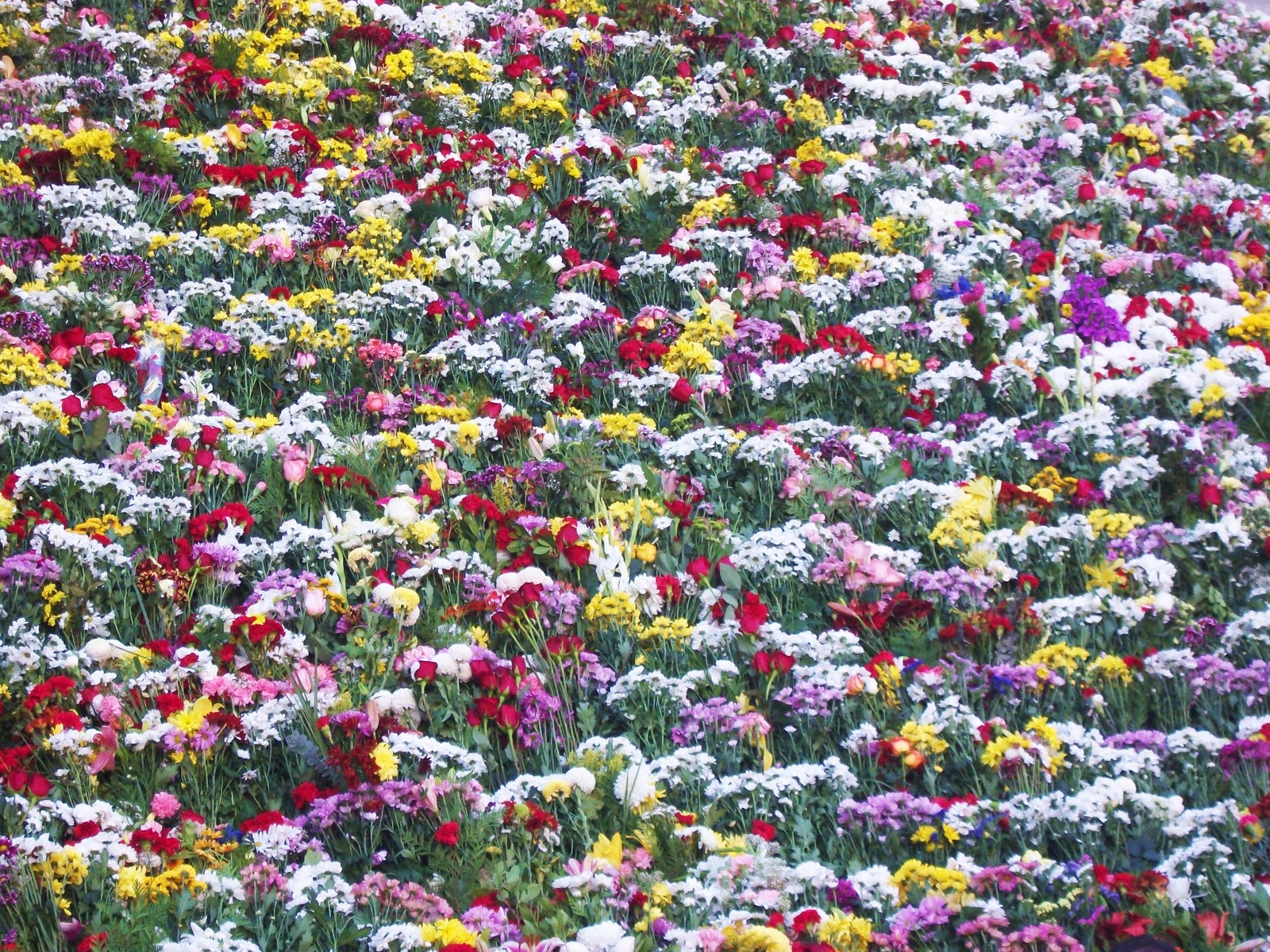
It was quite the spectacular sight to see. I clicked some photos and walked around the Cathedral watching all the people give their offerings and say a little prayer at the base of the statue of the Virgen. I wanted to step inside the Cathedral to see if there were anymore decorations but a service had just gotten out and no one was allowed to enter at that time. So I made my way back around the side streets passing more and more people with their flowers. Yet another great example of how much importantance Spain puts on the Christian religion.
Websites:
http://www.corazones.org/maria/almudena.htm
http://www.madridpedia.com/node/1325/
12 December 2010
An American Thanksgiving in Spain
This year I completely embraced the Thanksgiving tradition! Luckily, I work at the US Embassy on Thursdays so being an American holiday, all my students got the day off. Therefore, I did too! I took advantage of the oportunity to prepare a Thanksgiving feast for my roommates and some close friends.
I made several trips to the American store in the Embassy to pick up a few essentials and ordered my turkey from a local butcher. Turkey isn't as popular here as in the US so we bought only parts of the turkey. It was easier since there were only 5 of us and faster to cook.
 My friend Melissa, a Puerto Rican girl who recently moved to Madrid, was super excited to try a traditional mainland US Thanksgiving meal. She stopped by my place early in the afternoon to help me cook while all my other roommates were at work. We cranked Christmas music all afternoon as we were starting the feel the holiday spirit.


By the time my all my roommates got home, it was around 10 o'clock (typical dinner time in Spain). I put together the table and we all sat around where Nikki and I told stories about our past Thanksgivings back in the United States. We had to explain what all the food was to our Spanish compadres as they hungrily and confusingly stared at all the rarities on the table. When everything was out, we went around the table and said what we were thankful for that year. I said for the opportunity to share my culture and for experiences that I have been blessed to have throughtout my time here in Spain.

Then we dug in everything and went to sleep content and FULL!
That Saturday was also my company's Thanksgiving luncheon. This year we had it at Nicoletta, a really nice Italian resturant. It was fun getting a big group of Americans and non-Americans together to share amazing food, wine and some laughs.


After the lunch, a large group of us continued to some pubs and bars where we drank, chatted and danced the night away.


It was yet another interesting Dia de Accion de Gracias and I wouldn't have changed a thing :)
I made several trips to the American store in the Embassy to pick up a few essentials and ordered my turkey from a local butcher. Turkey isn't as popular here as in the US so we bought only parts of the turkey. It was easier since there were only 5 of us and faster to cook.


By the time my all my roommates got home, it was around 10 o'clock (typical dinner time in Spain). I put together the table and we all sat around where Nikki and I told stories about our past Thanksgivings back in the United States. We had to explain what all the food was to our Spanish compadres as they hungrily and confusingly stared at all the rarities on the table. When everything was out, we went around the table and said what we were thankful for that year. I said for the opportunity to share my culture and for experiences that I have been blessed to have throughtout my time here in Spain.

Then we dug in everything and went to sleep content and FULL!
That Saturday was also my company's Thanksgiving luncheon. This year we had it at Nicoletta, a really nice Italian resturant. It was fun getting a big group of Americans and non-Americans together to share amazing food, wine and some laughs.


After the lunch, a large group of us continued to some pubs and bars where we drank, chatted and danced the night away.


It was yet another interesting Dia de Accion de Gracias and I wouldn't have changed a thing :)
Subscribe to:
Posts (Atom)